

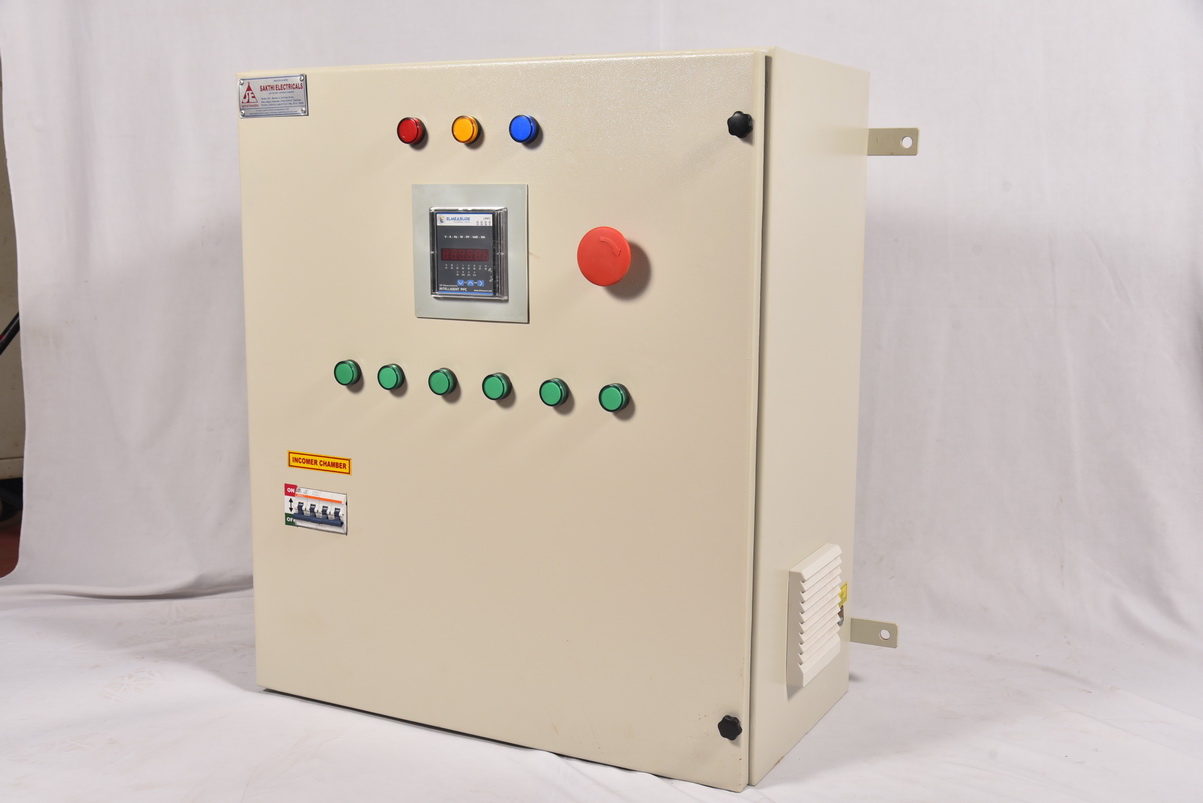
Stop paying for reactive power — APFC panels recover the cost of every kVAR.
Induction motors, welding machines, fluorescent and HID lighting, and most industrial loads draw reactive current (kVAR) in addition to the active current (kW) that does useful work. The reactive current flows through the supply transformer and cables, generating heat and voltage drop, but appearing in the bill as an inflated kVA demand and — in TNEB's tariff structure — as a direct surcharge when the monthly average power factor falls below 0.85. An APFC panel eliminates this by switching capacitor banks automatically to supply the reactive current locally, right at the point of consumption, so the transformer and mains only see active current.
Sakthi's APFC panels use a microprocessor-based power factor controller relay to monitor the installation's power factor continuously and switch capacitor steps via contactors in 12 to 16 increments — fine enough to maintain power factor within 0.95–1.00 under varying load without hunting. Where the installation has significant variable-frequency drives or other non-linear loads, detuned reactor-capacitor banks are specified to avoid harmonic resonance between the capacitor bank and the supply impedance, which can cause capacitor failure and supply distortion.
Typical applications
Automatically maintains power factor above 0.95 lagging to avoid TNEB penalty charges on reactive energy billing.
Installed at HT/LT incoming panels in textile mills, foundries, and pumping stations with large inductive motor loads.
Improves apparent power demand at the distribution transformer, reducing I²R feeder losses and cable heating.
Detuned reactor-based banks suppress harmonic resonance in facilities with variable frequency drives and UPS systems.
Tell us your spec. We'll build to it.
Share your ratio, accuracy class, burden and standard — our engineering team will quote the right unit.